
Study Background & Design
The purpose of our study is to examine day/night rhythms in how people pursue goals and rewards. For example, while some people tend to be excited and motivated to go after goals in the evening, others tend to be more motivated in the morning.
We are interested in how these daily rhythms may differ for people who do and do not have bipolar disorder. Ultimately, we hope that having more information about the mechanisms of differences in behaviour in people with bipolar disorder will help us better understand and treat bipolar disorder.
This project is being conducted by a team of researchers and clinicians from Swinburne University of Technology; University of California, Berkeley; and University College London. It is being funded by a grant from Breakthrough Discoveries for thriving with Bipolar Disorder (BD2), a philanthropic organisation.
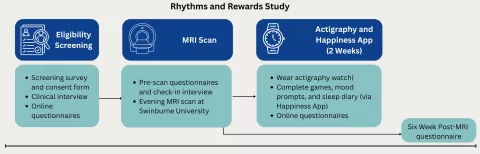
We will ask you to:
complete online surveys and interviews
complete tasks in an MRI brain scanner at Swinburne’s Hawthorn campus
for two weeks after the scan, wear a device on your wrist which measures your movement, temperature, light exposure, and sleep; and
over this period, use the Happiness App to play games and complete short daily surveys about your sleep, mood, and motivation
We expect that the total time commitment across the above study procedures will be approximately 8 hours.
Participation and Eligibility
We are recruiting people aged between 18-45 years who are based in Victoria, and who either:
- have been diagnosed with bipolar disorder, and are currently receiving care;
or - have no history of mania or depression
More specific information about eligibility criteria will be provided during sign-up.
Click here to read and sign the Participant Information and Consent Form, and fill in the first screening questionnaire.
Participation is voluntary. You can withdraw at any time if you decide the study isn’t right for you.
We will keep a record of a contact person responsible for your care in case we have concerns about your mental health or safety. This study is observational only and doesn’t affect your treatment.
We need to inform them of your participation in our study, and we need to be able to contact them in the rare event that we identify a significant concern during your MRI scan.
Treatment includes any intervention by a medical professional aimed at maintaining stable mood, such as therapy or prescribed medication.
Study Data
We collect data via:
- Online questionnaires and surveys
- An online video interview
- An actigraphy device (a watch) tracking movement, light, temperature, and sleep
- An app for short daily surveys about your mood and daily routines
- An MRI scan
All data will be securely stored on encrypted, password-protected servers which follow stringent data privacy standards.
Only the study team will have access to your information. If we publish or present data from this study, we will not use your name or any identifying information.
Results will be shared once the study is published. This may take several years.
Reimbursement
We will pay you via PayPal at the end of your participation. If you decide not to complete the study, we will aim to pay you within a week of learning of your study withdrawal for the assessments that you have completed.
Participants will be paid $40 per hour for the activities they complete in the study after they are deemed eligible to participate (i.e., after the initial eligibility screening survey and interview).
Your total reimbursement will depend on which assessments you complete, and how you perform on the MRI tasks. You can expect to earn up to $425 for taking part in this study if you have bipolar disorder, and up to $400 if you do not have bipolar disorder.
MRI
An MRI is a type of medical scanner which uses a strong magnet to take detailed pictures of the inside of the body. For our study, we will be taking pictures of your brain.
We will ask you to complete a small number of tasks while lying in the MRI scanner. You will also complete some additional questionnaires pre- and post-scan.
The MRI session will take place at Swinburne University of Technology, in Hawthorn, Melbourne. The full session will take approximately 2 hours and will take place in the evening, beginning at 7pm. You’ll be in the scanner itself for 1 hour, during which you will complete several tasks.
Ahead of your scheduled MRI session, we will provide more information about how to get to the scanner, and discuss your preferred method of transport. If you need, we are able to cover the cost of a rideshare service to get you to and from the session.
MRI scanners are widely used in both clinical and research settings, and there are minimal risks involved. Our research team and on-site MRI technician follow strict policies and procedures to ensure that you will be perfectly safe in the scanner.
We will also complete an MRI safety checklist with you in advance, to make sure that you’re safe to go into the scanner.
No, the MRI scanner uses a powerful magnet to take images. The scan does not involve any radiation or contrast.
Yes. The MRI machine produces a strong, constant magnetic field. This means you will have to remove any metal objects (e.g., earrings, necklaces) prior to the scan. We will provide you with a secure space to place your belongings.
As above, we will complete a thorough MRI safety checklist with you to examine if there is any reason you may not be able to complete the scan.
If you have any non-removable magnetic metal devices in your body (e.g., cardiac pacemaker or defibrillator, aneurysm clip, neurostimulator, cochlear/stapes implant, shrapnel), you will not be able to complete the MRI scan. Although there is no evidence than an MRI brain scan is harmful to a fetus, we will also not scan people who are pregnant as a precautionary measure.
In many cases, people with dental appliances in their mouths (e.g., dental plates) are still able to safely complete an MRI scan. This is something we can discuss with you on a case-by-case basis.
If you are interested, we can send you images or a video of your brain after the scan.
Happiness App and Actigraphy
You will be asked to complete:
• Prompts about your mood, motivation and activities (8x per day, for 14 days) - Approx. 1 minute each
• Sleep diary (1x per day, for 14 days) - Approx. 2 minutes each
• Short games (3-5x per day, for 10 days) - Approx. 3-5 minutes each
The research team will guide you through the process of installing and using the app once you are enrolled in the study.
The actigraph is a waterproof wrist-worn device, similar to a watch, that tracks movement, light, temperature, and sleep. We are using it to study how daily rhythms in activity and light exposure are linked to reward processes in bipolar disorder.
You’ll be asked to wear the actigraphy watch for a 14-day period, worn 24/7 (including during sleep or while showering).
Please contact the research team and let us know as soon as possible. If after hours, leave a message or email.
Let us know in advance. When we book your MRI session, we will work with you to make sure that you have a 2-week period afterwards where you are free to wear the device.
That's okay, just keep us informed so we can interpret your data correctly.
Interviews
We will conduct two interviews with you: one baseline interview (approx. 2 hours) to check your eligibility, and one symptom check-in interview (approx. 1 hour) 1 or 2 days prior to your MRI scan.
Yes, to ensure accurate data. Recordings are securely stored and accessed only by the research team.
You can skip questions or pause the interview at any time. For treatment or urgent care, please contact your healthcare provider or use crisis resources listed in the Participant Information and Consent Form (PICF).